
A pressure reducing valve (PRV) is a straightforward device that prevents excessive municipal pressure from damaging home plumbing. Some municipal mains run above 100 psi, and certain systems can even exceed 200 psi. Many plumbing codes require or recommend a PRV when inlet pressure rises above roughly 80 psi. For many homes, a 50–70 psi target supports plumbing protection with comfortable showers, reliable fixtures, and smooth irrigation performance.
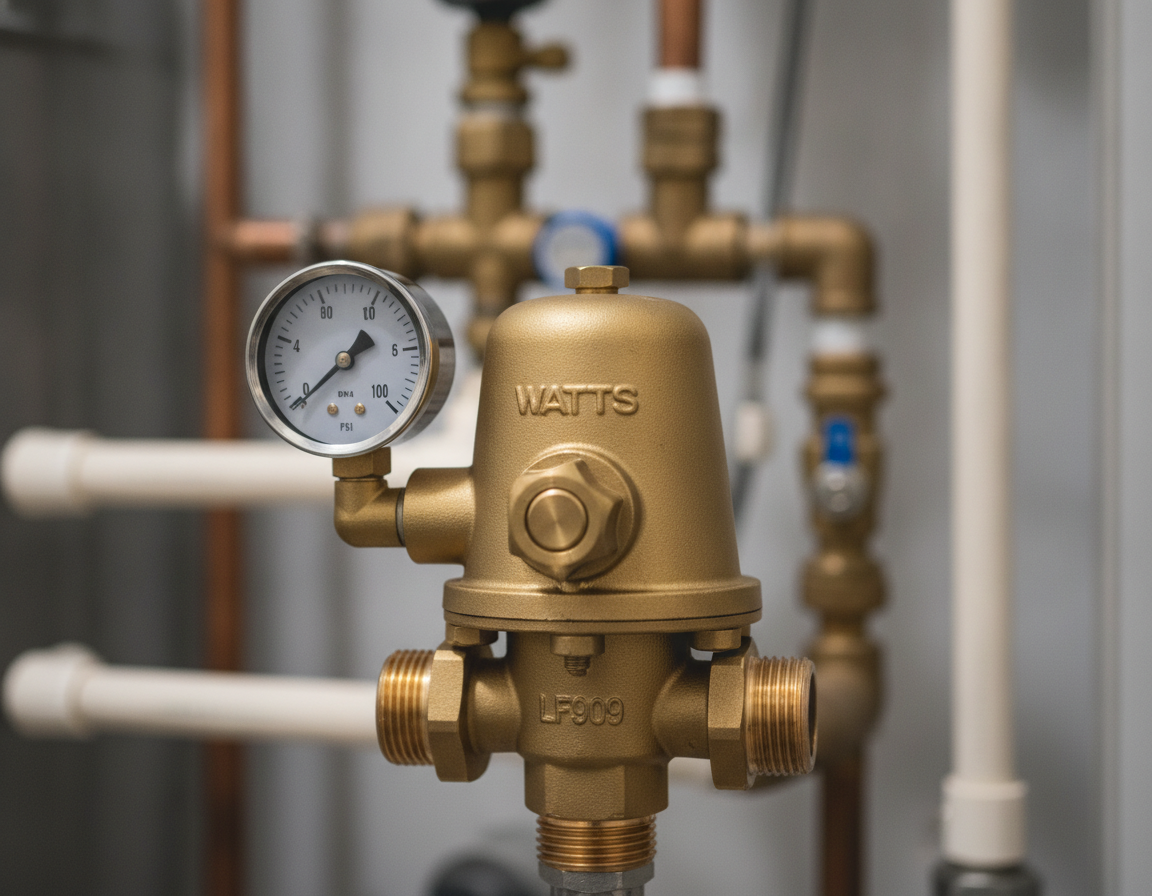
Watts Water Pressure Regulator
Watts has been making water-control products for over a century, and Watts Water Regulator models are available for many everyday residential systems. Watts WPRVs use a spring-loaded diaphragm and seat assembly to drop and stabilize incoming pressure. Common residential models, including LF25AUB and LFN55B, serve 1/2″–2″ piping and commonly adjust within about 25–75 psi.
A Watts Water Pressure Regulator is typically installed just downstream of the water meter or main shutoff. Proper sizing and placement reduce noise, avoid premature valve wear, and ensure steady performance. Many Watts regulators offer features like built-in strainers, gauge ports, and thermal-expansion bypass options for modern plumbing requirements.
Homeowners can confirm regulated pressure with a simple gauge at an exterior hose bib. If pressure fluctuates or the regulator will not keep a set pressure, a licensed plumber should inspect the diaphragm, seat, and fittings. Installation Parts Supply carries common Watts Regulator models, repair parts, gauges, and accessories for residential PRV installations.
- A PRV helps protect home plumbing from high municipal pressure and is commonly required when supply pressure exceeds about 80 psi.
- Watts Water Pressure Regulator models use a spring-loaded diaphragm to stabilize pressure.
- A common home pressure target is 50–70 psi because it balances fixture performance with pipe and appliance protection.
- For best results, install the regulator near the meter and size it with the manufacturer’s flow-capacity tables.
- Use a hose-bib gauge for pressure checks, and source common Watts parts through Installation Parts Supply.
Why Install A Pressure Regulator: Benefits For Homeowners And Savings
High municipal main pressures can exceed 200 psi, placing heavy stress on home plumbing. A correctly adjusted pressure regulator lowers that incoming pressure to a safer, more manageable range. This protects pipes and fixtures and stabilizes flow when supply pressure fluctuates. Many codes require a pressure reducing valve for mains over 80 psi, making a Watts Water Pressure Regulator a common solution.
How Regulators Protect Pipes, Fixtures, And Appliances
Excess pressure can cause pinhole leaks, cracked fittings, and early failure of appliances such as washing machines and water heaters. Installing a Watts Water Regulator at the building inlet lowers harmful pressure peaks. Stable downstream pressure limits the risk of burst pipes while easing strain on valves, fittings, and fixture cartridges.
How PRVs Can Save Water, Energy, And Sewer Costs
Water flow rises quickly as pressure increases, and far more water can pass through fixtures at 150 psi than at 50 psi. Lowering supply pressure can reduce household water use and cut the energy needed to heat domestic hot water. Watts materials indicate that a pressure reducing valve may reduce hot-water energy demand in many homes, which can support lower water waste and utility costs.
Many municipal sewer charges are tied to metered water volume. When a residential PRV reduces water use, homeowners may also see lower wastewater-related charges. For compatible parts, Installation Parts Supply carries Watts regulators and accessories that can support code compliance and water-efficiency goals.
Better Comfort And Longer System Life
A target range around 60–70 psi can give steady showers while reducing banging, humming, and noisy fixtures. Stable regulated pressure can help appliances operate more consistently and may extend the life of water heaters, valves, and fixture parts. Adding thermal expansion controls when needed prevents T&P valve nuisance discharge, keeping the system quieter and more reliable.
Monthly gauge checks at an accessible hose bib help maintain settings and reveal changes early. Homeowners who pair a quality Watts Water Pressure Regulator with proper accessories gain the main residential PRV benefits of protection, savings, and long-term reliability.
Watts Water Pressure Regulator
Watts provides a wide range of pressure regulators for homes and light commercial settings. The product range includes compact direct-acting regulators as well as larger pilot-operated valves. Homeowners can choose suitable options based on pipe size, flow requirements, and installation limits. Watts regulators are widely used because they offer consistent performance and commonly carry recognized approvals.
Overview Of WPRV Product Families And Models
For typical residential systems, models like LF25AUB and LFU5B are commonly used on 1/2″ to 2″ service lines. They offer adjustable ranges near 25–75 psi. Higher-capacity models such as LF223 and LF115 are intended for larger lines, greater flow needs, and higher pressure applications. Specialty series such as SS263AP and P60 address stainless, food-grade, or specialized installation requirements.
Installation Parts Supply offers these common lines with several end-connection choices. These include threaded, solder, PEX, CPVC, press, and quick-connect fittings. That range of choices makes it easier to match the valve to different plumbing materials and installation layouts.
Manufacturers provide capacity tables and performance curves to guide selection. It is important to choose a model that meets expected flow and desired downstream pressure. This provides a useful margin when fixtures, appliances, and irrigation demand peak at the same time.
Common Features And Regulatory Approvals
Many Watts Regulator models offer built-in strainers, EZ-set adjustment features, gauge ports, and covers designed for easier service. These features help make inspection, adjustment, and maintenance more convenient. Lead-free wetted components help comply with current regulatory limits for potable systems.
Certifications such as NSF 61-G/372 and ASSE 1003 are common on many models. Those approvals help provide confidence for domestic potable-water installations. Options such as stainless construction and FDA-approved materials serve specialized applications.
Installation Parts Supply typically lists model specifics so homeowners and plumbers can confirm approvals and end connections before ordering. Checking these details before ordering reduces fit problems and delays.
How The Valve Works: Direct-Acting Versus Pilot-Operated
Direct-acting regulators control flow with a spring-loaded diaphragm working against a valve seat. They respond quickly and suit typical residential loads. The LF25AUB is a common example that provides steady pressure control for many single-family systems.
Pilot-operated designs separate sensing and main valve stages. The pilot monitors downstream pressure and controls the main valve to maintain stability during higher flow demand. Models such as LF223 and LF115 suit larger mains and commercial systems where minimal setpoint drift is important.
For accurate downstream pressure control, install the regulator near the meter or main shutoff. Easy-to-access gauge ports make setup, testing, adjustment, and service much simpler.
Sizing, Selection, And Installation Best Practices For Reliable Home Use
Selecting the proper regulator starts with realistic demand estimates and a clear installation plan. Manufacturer curves and capacity tables should be used to match valve flow rates with household demand. It is best to operate the regulator near the middle of its rated range to avoid hunting or noisy operation. When inlet pressure is high or the reduction ratio is large, staged pressure reduction can improve control and extend valve life.
Correct Regulator Sizing Steps
Start by calculating peak flow for fixtures, irrigation, and appliances. Then compare that demand with Watts Water Pressure Regulator capacity data at typical selection points, such as the 20 psi fall-off shown in manufacturer tables. As a rule of thumb, minimum flow through the valve should generally be about 10–15% of the maximum intended flow.
Avoid oversized valves to prevent wire drawing and noise. Undersized valves can starve downstream demand. Where flow varies, choose a valve that covers the expected range without constantly operating at the edge of its curve.
Recommended Regulator Installation Configurations
Install the regulator right after the meter or main shutoff, with isolation shutoffs and unions for service. When inlet pressure exceeds about 150–200 psi, or when the reduction ratio approaches 3:1, use two regulators in series to divide the pressure drop.
For continuous service or highly variable peaks, parallel installation with two staged valves works well. Set one valve about 10 psi higher than the other to stage flow response. Watts suggests placing the lower-set valve in the main run and the higher-set valve on the saddle for easier maintenance and better capacity alignment with peak demand.
Practical Installation Tips And Required Accessories
Select end connections that match the plumbing material, such as PEX, CPVC, press, sweat, or flanged options, so installation is cleaner and code-appropriate. Include unions, isolation shutoffs, and tailpiece kits so the Watts Water Regulator can be serviced or removed without cutting the line. Install a gauge on the downstream side so the setpoint and performance can be verified.
When a check valve or backflow preventer creates a closed system, consider a regulator with thermal expansion bypass and use a dedicated expansion tank for proper control. For larger systems, LR115-style and other automatic control valves from 1 1/4″–16″ can be installed in parallel or series to increase capacity, control, and redundancy.
| Installation Requirement | Best Practice | Why it matters |
|---|---|---|
| Pressure selection | Select the regulator by GPM using Watts tables at the 20 psi fall-off point | Ensures valve operates near mid-range for stability |
| Excessive incoming pressure | Split the pressure drop with staged regulators on high-pressure services | Limits valve stress and improves pressure control |
| Variable peak flows | Use parallel regulators with slightly different setpoints | Maintains service during maintenance and peaks |
| Maintenance access | Include unions, shutoffs, gauges, repair kits | Makes repairs faster and avoids downtime |
| Expansion control | Use regulators with bypass plus a dedicated expansion tank | Controls pressure rise and reduces relief-valve discharge |
| Sourcing parts | Purchase compatible Watts parts and installation accessories | Compatible parts help complete the job correctly and efficiently |
Maintenance, Troubleshooting, And When To Replace
Regular maintenance extends the life of a pressure regulator and prevents unexpected failures. Conduct monthly or quarterly visual inspections for leaks, drips, or corrosion. Also clean or replace integral strainers if flow appears restricted. Ensure unions and a bypass line are accessible for easier maintenance.
Verify downstream pressure with a gauge at a hose bib or water heater. Residential targets are usually around 60–70 psi and should not exceed 80 psi. Record this reading during inspections and after any adjustment to confirm the regulator is holding its setpoint.
Routine Regulator Checks And Maintenance
Look for slow leaks, loose fittings, and mineral buildup. Clean the strainer screen when debris is present. Apply light lubrication to external adjustment components to prevent seizing. Keep records of inspection dates and pressure readings to track trends.
How To Diagnose Common Regulator Problems
Warning signs include fluctuating pressure, banging pipes, humming sounds, and unstable flow. Pressure that stays too high or too low can also point to a regulator problem. A regulator that will not hold an adjustment may have a worn seat, damaged diaphragm, or trapped debris. Use multiple pressure readings to distinguish supply-side issues from regulator faults.
Repair, Replacement, And Expected Service Life
A regulator often lasts about 10–15 years, though service life depends on water quality, usage patterns, and installation conditions. Persistent leaks, visible corrosion, or repeated failures indicate replacement may be needed. Watts offers model-specific parts, and many faults can be fixed with a PRV repair kit.
When choosing repair, follow manufacturer instructions and use genuine parts from trusted sources. Installation Parts Supply stocks Watts repair kits, pressure gauges, accessories, and replacement regulators. For complex issues such as a failed diaphragm or worn seat, consult a licensed plumber for diagnosis and decision-making.
When replacing an older regulator, consider newer Watts models with EZ-Set adjustment, gauge ports, thermal bypass features, or improved capacity. Proper installation and timely troubleshooting prevent downstream damage and improve service life.
Conclusion
A Watts Water Pressure Regulator plays an important role in safe and efficient residential plumbing. Common models such as LF25AUB and LFN55B serve many homes, while LF223 and P60 fit larger or more specialized needs. They lower high pressure to safer levels and help protect the home.
Choosing the right size and following installation steps are key. Routine pressure checks and inspections are also important. Use Watts Regulator tables, curves, and model data to match the valve to household demand. A basic pressure-gauge test can confirm whether the system is operating at the desired pressure.
If pressure problems continue, contact a licensed plumber. Regular maintenance and genuine parts are important for lasting performance. Installation Parts Supply offers authentic valves and accessories for U.S. homes.
This guide shows the value of a well-chosen Watts Water Pressure Regulator. A correctly sized and maintained regulator can reduce repair costs, water use, energy demand, and system wear. Always follow manufacturer guidelines and seek expert advice when needed.
Related: Choosing Between Brass And Bronze Watts Water Regulators